President Donald Trump arrived at Shenzhen Baoan International Airport in China, where President Xi Jinping personally welcomed him on the tarmac. Chinese youth greeted Trump with chants of welcome as American and Chinese flags were displayed together. The leaders embraced before heading to the Asia-Pacific Economic Cooperation (APEC) welcoming dinner, where Russian President Vladimir Putin approached Trump for a handshake.
The welcoming ceremony set the stage for diplomatic negotiations between the United States, China, and Russia. Trump and Xi were scheduled to hold bilateral talks before joining Putin for a trilateral meeting. The Kremlin also indicated that a separate Trump-Putin conversation could take place, and Trump expressed willingness to meet privately with the Russian president, although no additional meeting had been confirmed.
Chinese authorities imposed extensive security measures across downtown Shenzhen, deploying police, military personnel, checkpoints, and large presidential motorcades around the summit. Despite the heightened security, crowds lined the streets late into the night hoping to catch a glimpse of Trump. Elon Musk was also in Shenzhen and traveled aboard a motorcade bus connected to the summit activities.
Shenzhen provided a backdrop for the gathering because of its transformation from a village into a major Chinese technology center. Following Chairman Mao’s death, Deng Xiaoping introduced market reforms influenced by the economic success of nearby Hong Kong. Xi Jinping’s father helped establish Shenzhen as an early Chinese free-trade zone, creating a foundation for economic expansion.
Trade negotiations emerged as a major priority ahead of Trump’s meeting with Xi, with reports indicating that China could reduce tariffs and expand access for American goods. Such concessions would address longstanding complaints that Beijing restricts foreign products from entering its domestic market. For Washington, the negotiations also aligned with Trump’s push to restore American manufacturing and strengthen domestic employment.
The White House chief of staff’s office was reportedly pushing to revive Trump’s original Make America Great Again priorities, particularly deportations, trade reform, and returning manufacturing to American shores. These efforts reflected Trump’s longstanding criticism of Chinese trade practices dating back to his 2015 and 2016 campaigns. Greater access to Chinese markets and rebuilding American industrial capacity remained central objectives.
Alongside the trade discussions, Nvidia became the focus of a semiconductor security controversy following the reported removal of Jensen Wong. Allegations involving Alice Wang and purported connections to China’s Ministry of State Security raised concerns about a possible honeypot operation targeting Nvidia leadership. Claims that Chinese Communist Party interests and mainstream media organizations contributed to Wong’s removal remained disputed, and the extent of any technology compromise was unknown.
The controversy intensified concerns about America’s dependence on overseas semiconductor production, particularly in Taiwan. Former federal prosecutor Don Brown argued that Chinese technology acquisition and previous American trade practices had exposed vulnerabilities across United States military, economic, and financial systems. Advanced microchips supporting artificial intelligence platforms, including Google’s systems, remained central to the broader competition for technological dominance.
Concerns about American infrastructure security intensified amid reports of banking disruptions, possible cyberattacks affecting approximately 178 major United States companies, and a shutdown occurring approximately 30 minutes after an aircraft landed in Dallas. Questions emerged about whether these incidents involved coordinated cyber warfare. However, Secretary of State Marco Rubio rejected suggestions of covert activity or hacking, and the administration had not confirmed a foreign cyberattack.
Meanwhile, the Russia-Ukraine war continued despite diplomatic engagement between Washington and Moscow. Long-range strikes were reported around Moscow, St. Petersburg, Kyiv, and the Kerch Strait Bridge. Recent negotiations in Abu Dhabi involving Steve Witkoff and Jared Kushner had reportedly produced encouraging signs, but no agreement emerged. An earlier 28-point peace proposal from autumn 2025 remained a point of discussion amid disagreements involving the State Department and Capitol Hill.
The ongoing conflict involving Iran added another complication to relations between Washington and Beijing, particularly because Iran supplies energy to China. Reports suggested that the United States had explored asking China to mediate, although the White House had not substantially confirmed those discussions. Beijing’s potential involvement remained uncertain as the conflict continued to intersect with Chinese economic and strategic interests.
Beyond the ongoing wars, Taiwan and nuclear arms control remained major concerns surrounding the trilateral summit. Beijing continued viewing Taiwan as a province awaiting reunification following the Chinese Civil War and Communist Revolution of 1949. At the same time, the expiration of an existing nuclear arms control treaty and Russian interest in renewed negotiations raised questions about strategic stability. Elon Musk also questioned whether confrontation between an established power and a rising power could be avoided.
FINAL WORD
The Shenzhen summit brings together diplomatic negotiations, economic competition, and international security concerns as the United States, China, and Russia confront overlapping disputes involving trade, technology, and military power. American efforts to restore manufacturing and protect semiconductor technology intersect with concerns about cyber vulnerabilities, while the conflicts involving Ukraine and Iran and tensions over Taiwan demonstrate how regional confrontations affect relations among the major powers. Together, these developments place trade policy, technological security, nuclear arms control, and conflict resolution within a broader struggle over economic influence, national security, and international stability.
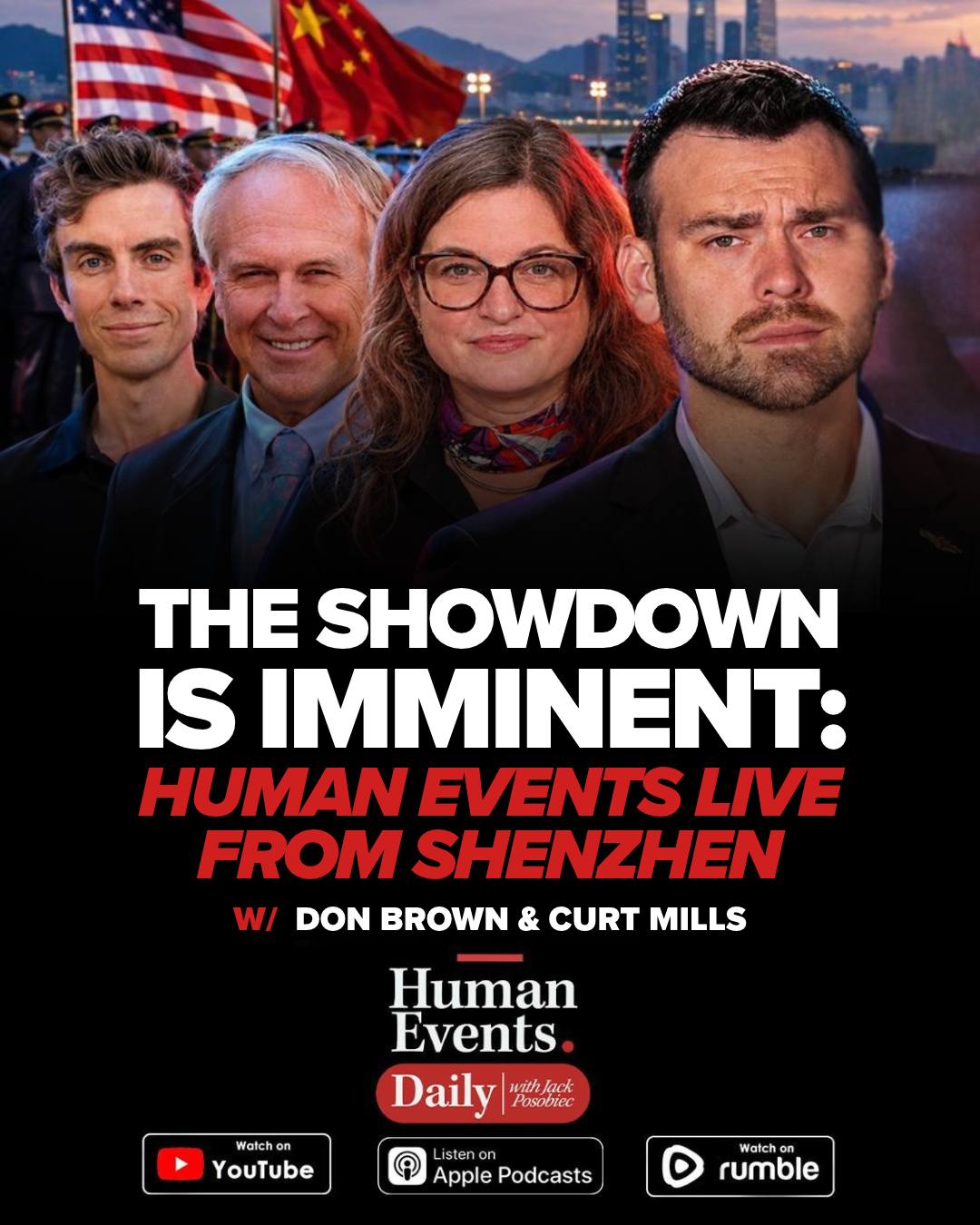
On today's episode of Human Events Daily, I'm covering President Trump's historic summit with Xi Jinping and Vladimir Putin in Shenzhen, China, as the three leaders prepare for critical negotiations over trade, technology, and global security.