Tyler Robinson will face trial in the killing of Charlie Kirk after a judge ruled that the case could proceed following the preliminary hearing in Provo, Utah. The trial date announced yesterday is June 2028, placing its scheduled opening almost three years after Kirk’s September ten, 2025, murder, with further postponements still possible.
Prosecutors’ decision to seek the death penalty adds procedural demands that help explain the extended timetable. Attorney Andrew Branca explained that capital cases carry heightened constitutional protections and require painstaking preparation from the defense to protect the accused and from prosecutors to secure a result that withstands subsequent challenges.
Those requirements extend to jury selection and deliberations. The same jurors would determine guilt and then separately consider capital punishment, while prospective jurors would be questioned about whether moral or religious objections would prevent them from imposing the death penalty when supported by the facts and law. Branca also warned that prospective jurors sometimes conceal their views to gain seats in prominent trials.
Courtroom management remains a concern because Judge Graf had reportedly served on the bench for approximately one month when the case arose. During the preliminary hearing, defense questioning about the validity of DNA science continued for hours, prompting criticism of the judge’s willingness to accommodate both sides. Branca warned that either legal team could exploit perceived weakness and emphasized the need for firm rulings and control of the courtroom.
Democrats and some Republicans are pushing impeachment articles against Defense Secretary Pete Hegseth in the House today, during the lame-duck Congress. Republican Representative Thomas Massie of Kentucky accuses Hegseth of breaking the law, placing the defense secretary’s conduct under congressional scrutiny following the Democratic midterm sweep.
The dispute centers on whether Hegseth’s execution of President Donald Trump’s military directives constitutes an impeachable offense. The argument against impeachment holds that the articles concern policy disagreements rather than treason, bribery, or high crimes and misdemeanors, and that Hegseth exercises no independent war-making authority outside the president’s chain of command.
Attorney Andrew Branca defended presidential control of military operations while distinguishing armed hostilities from a formal declaration of war. He argued that Congress alone can declare war and place the country on a war footing involving military conscription, rationing, and resource allocation, but maintained that presidents have repeatedly ordered military action without declarations of war or congressional authorizations since the 1973 War Powers Resolution.
That constitutional defense was paired with an acknowledgment that impeachment depends on congressional votes and that high crimes and misdemeanors are undefined in the Constitution. Branca argued that opposition to Trump’s military policies should be pursued through elections and policy changes. The objection to targeting Hegseth was that Congress would be using impeachment against a subordinate for operations directed by the commander in chief.
Trump’s Truth Social announcement raised the prospect of shifting the Iran operation toward a Gulf nation-led force that would monitor Iran, reducing the United States’ leadership role in the operation. An Arab-led force involving the Gulf Cooperation Council and potentially additional regional partners was presented as a possible route toward ending the current phase of the war and establishing a more durable regional security arrangement.
Qatar’s mediation provides a diplomatic channel for that potential transition. Qatar has worked between the United States and Iran throughout the war, intensified its efforts before the midterm elections, and has itself recently been bombed by both Israel and Iran, giving it a direct stake in preventing further escalation.
Alongside Qatar’s mediation, Trump approved Vice President JD Vance’s letter to Rezaei, an influential adviser to Iran’s supreme leader, seeking a conversation or meeting. Turkish media reported yesterday that a meeting was scheduled for next week, but the report remained unconfirmed. Vance’s June meeting with Iran’s parliamentary speaker in Pakistan had already established direct contact at a senior level.
These diplomatic efforts face competing preferences within the administration: Hegseth favors escalation, Marco Rubio favors sanctions, and Vance favors diplomacy. Following Republican losses in Mississippi, Alaska, Maine, Texas, South Carolina, and Kansas, Vance acknowledged that the Iran war cost the administration the election and called for reassessing the relationship with Israel. Trump responded favorably to Vance’s statement, while the proposed Gulf security arrangement offered a possible alternative to further military escalation.
FINAL WORD
The case against impeaching Hegseth rests on President Trump’s authority to direct military operations and the distinction between policy disagreements and impeachable offenses. Trump’s support for talks with Iran offers a way to end the war and let Gulf nations take responsibility for monitoring Iran. As Congress challenges military decisions and Trump pursues diplomacy, Utah’s courts must deliver a fair trial for Tyler Robinson while prosecutors seek the death penalty in Charlie Kirk’s killing.
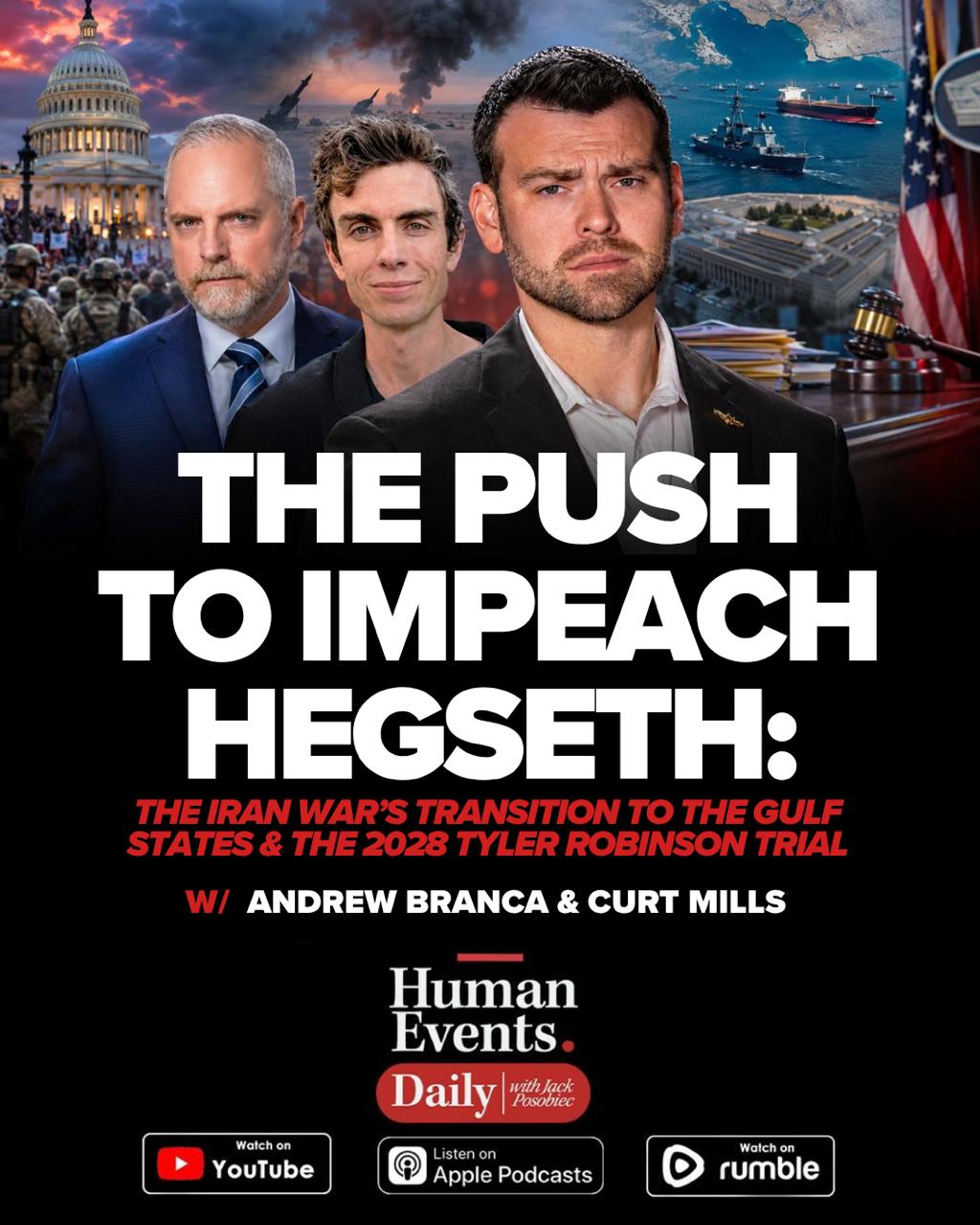
On today's episode of Human Events Daily, I explain why the impeachment push against War Secretary Pete Hegseth targets policy disagreements over military operations ordered by President Trump.