Thanks for signing up for Poso Daily Brief. You will be receiving a newsletter Monday through Friday.
Subscribe
Oct 2, 2026 | Poso Daily Brief
2 OCT 26 SITREP
1. JD Vance Interview Backlash And Republican Party Divide
During his recent exclusive interview with Jack Posobiec, Vice President JD Vance supported eliminating the H-1B visa program, argued that the Trump administration should work to end anti-white and anti-male discrimination in the West, criticized 40 years of globalism, and acknowledged that Americans have legitimate reasons to be dissatisfied with current economic conditions.
Vance’s remarks went viral following the interview, drawing more than 10 million views across the internet and prompting backlash from the Cato Institute, Mark Levin, Peter Laffin, Frank Fleming, and other conservatives, including accusations that his positions amounted to socialism, white nationalism, or identity politics.
The backlash exposed a broader divide between Vance’s positions and Republicans associated with the George W. Bush and Karl Rove era, particularly over laissez-faire economics, the movement of American jobs overseas, the importation of foreign workers through programs such as H-1B, deindustrialization, and the economic consequences of globalism for American workers.
Vance’s criticism of globalism became another major point of contention, while pollster Rich Baris connected the opposition to Vance with the neoconservative wing of the Republican Party and traced neoconservatives from their break with the Democratic Party during the Vietnam War, through their entry into the Republican coalition under Ronald Reagan, to their later influence during the George W. Bush era.
2. Young Men, Economic Pressures, And Republican Outreach
The backlash to the Vance interview developed into a broader debate over whether the Republican Party understands the economic and social pressures facing Gen Z and younger men. Charlie Kirk had raised the same concerns in 2024 and 2025, arguing that Gen Z faces economic circumstances different from previous generations and that Republicans must begin by listening to younger Americans and understanding the conditions affecting their lives.
Vance’s positions on H-1B visas, manufacturing, globalism, and the economy placed employment opportunities and deindustrialization at the center of that debate. Ohio and Pennsylvania were cited as Rust Belt states confronting similar economic forces, reinforcing concerns that younger Americans are entering the workforce after decades in which American jobs were moved overseas while foreign workers were brought into the United States.
Earlier in the week, Arkansas Governor Sarah Huckabee Sanders faced backlash over an advertisement portraying a young white male gamer named Brad as a welfare freeloader. The criticism of the advertisement fed directly into the wider dispute over the Republican Party’s treatment of younger white men, since young white men are the least likely group to receive government assistance.
That controversy also placed gamers within the larger debate over younger men and the Republican coalition because gamers had already demonstrated their ability to organize during the 2014 Gamergate movement. Foundation for Freedom Online Managing Director Allum Bokhari emphasized that gamers have built grassroots digital organizations without institutional political support, while pollster Rich Baris identified younger men as a crucial component of Donald Trump’s 2024 electoral coalition and argued that dismissing their economic and social concerns risks alienating voters the Republican Party depends on.
3. Artificial Intelligence, Big Tech, And Institutional Control
Allum Bokhari argued that criticism of big technology companies should be separated from opposition to the underlying technology, citing social media’s ability to give ordinary people a voice, disrupt legacy media, and support political organization while criticizing previous cooperation among technology companies, nonprofits, media organizations, and government-linked institutions to censor political speech.
Bokhari credited Elon Musk and Mark Zuckerberg with moving away from censorship and pointed to the European Union, permanent bureaucracies, media organizations, and NGOs as forces seeking greater control over technology. He argued that artificial intelligence threatens existing control over information as well as established interests in Hollywood and large animation studios.
Model Evaluation and Threat Research, or METR, has raised tens of millions of dollars around concerns about an artificial intelligence apocalypse and has sought access to AI companies’ safety protocols, while Anthropic CEO Dario Amodei has supported METR’s efforts to establish broader oversight across the artificial intelligence industry.
The Foundation for Freedom Online reported that METR was working with the RAND Corporation, which Bokhari connected to NewsGuard and its blacklists of disfavored media organizations. Bokhari also compared the emerging AI safety structure to previous efforts by governments, advertisers, NGOs, and third-party disinformation organizations to gain influence inside social media trust-and-safety operations.
FINAL WORD
Trump’s agenda is forcing Republicans to confront the economic problems that have left American workers and younger men behind. Protecting American jobs and keeping powerful institutions accountable remain central to the movement he built. As the midterms approach, Republicans will have to show voters they can deliver on those priorities or face the consequences.
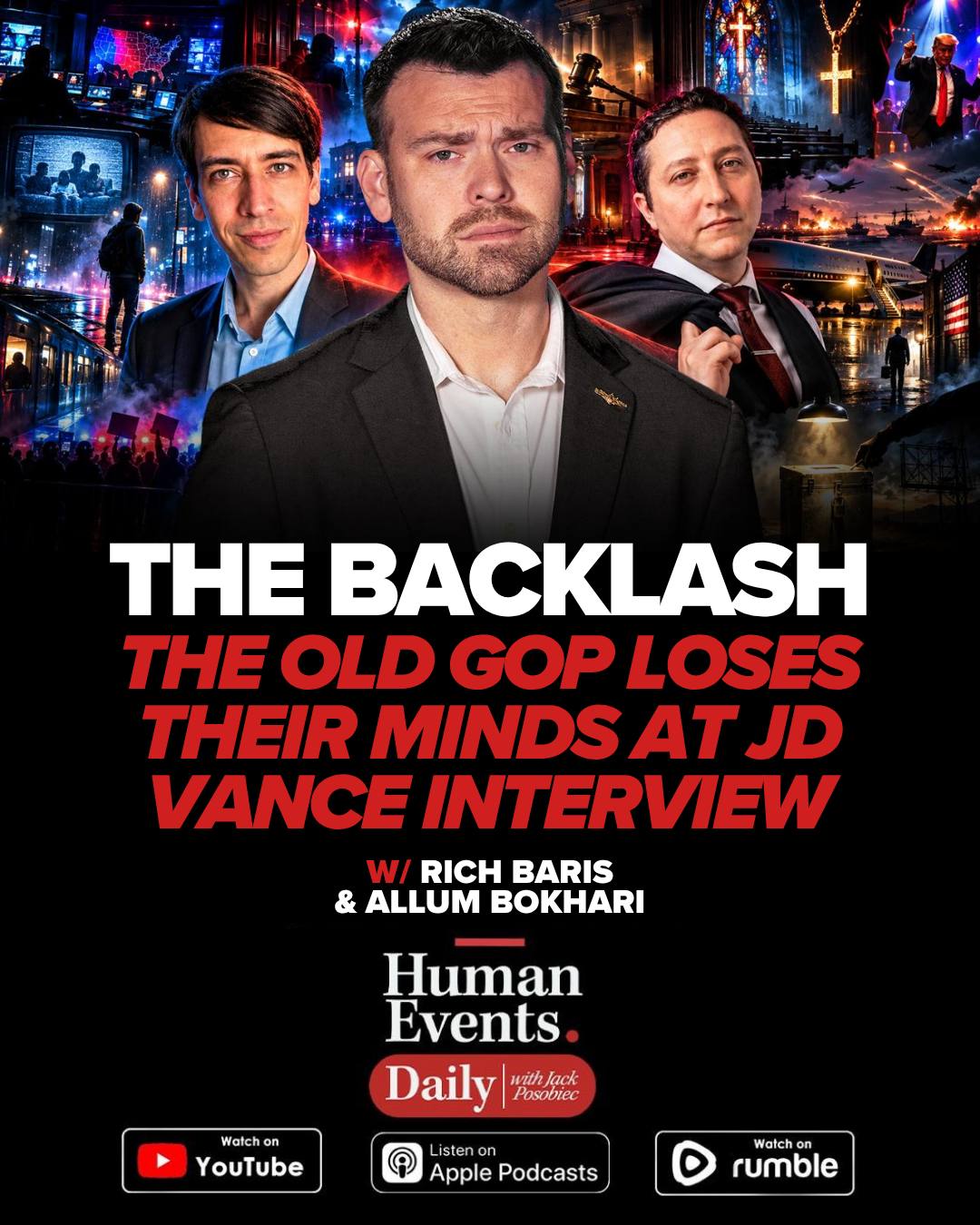
On today's episode of Human Events Daily, there's an undeniable war on white people in the West. This is something that's very clear. It's something that Charlie Kirk talked about at length. It's something that a lot of us have pointed out over the years.