Thanks for signing up for Poso Daily Brief. You will be receiving a newsletter Monday through Friday.
Subscribe
Sep 1, 2026 | Poso Daily Brief
1 SEP 26 SITREP
1. Judge Graf Rules Tyler Robinson Will Stand Trial For The Murder Of Charlie Kirk
Judge Tony Graf ruled that the prosecution established probable cause on all seven counts, sending the case to trial; count one, aggravated murder, carries the death penalty if Robinson is convicted, and Robinson pleaded not guilty to all counts following the ruling.
Prosecutor Ryan McBride built the state's case around four categories of evidence: surveillance video of Robinson on the Utah Valley University campus on September 10, 2025 wearing the same clothes he had on when he turned himself in; Robinson's DNA found on the scope, grips, stock, and trigger of the rifle recovered in the woods near the Losee Center; Robinson's own written and digital admissions including a note left for Lance Twiggs, text messages sent to Twiggs after the shooting, and statements in a Discord group; and circumstantial evidence of motive, means, and opportunity.
Defense attorney Staci Visser argued the great risk of death aggravating factor was not met because there was one shot, one bullet, and one victim, and that the bolt-action rifle having only one spent cartridge actually undercut the state's claim that others were endangered; attorney Michael Burt challenged the DNA evidence by pointing out that experts testified Robinson was only a possible contributor and that other firearms could have fired the bullet recovered from Kirk's body.
Prosecutor Chad Grunander closed for the state arguing that firing a rifle into a crowd of over 3,000 people from 415 feet away created an undeniable zone of danger, noting that a micro movement of the barrel caused by wind, a nervous breath, or a flinch could have shifted the bullet several feet, and that writings engraved on the bullets including the phrase "Hey fascist, catch" demonstrated Robinson's hatred of Kirk's political expression.
2. Lindsay Clancy Murder Trial Jury Deadlock In Plymouth
The jury in the Lindsay Clancy murder trial in Plymouth, Massachusetts sent a note to the judge stating that after many hours of deliberation across a trial involving over 80 witnesses and over 300 exhibits, jurors were unable to reach a unanimous decision; the judge directed the jury to return to deliberations rather than declare a mistrial.
The jury comprised nine women and three men, and the possibility of a hung jury arose alongside speculation that the three male jurors were the holdouts voting for conviction while some female jurors remained sympathetic to Clancy.
Clancy, a former nurse, informed both her husband and her mother-in-law before the murders that she had concerns she might harm her children, yet she disclosed none of those thoughts to the mental health professionals she saw during the 11 months leading up to the killings, professionals who were themselves required to notify police of such disclosures, a fact attorney Jay Town cited as proof she understood the wrongfulness of her actions.
The murders, in which Clancy killed her three children in a basement, occurred in January 2023, leaving the case pending for nearly four years before reaching the jury verdict phase; Jay Town characterized an 18-month delay for a mental health defense as reasonable but called a four-year timeline excessive.
3. Social Media Influence And Jury Integrity Concerns Across Both Trials
Jay Town also stated that he does not believe a single juror in the Clancy case, or eventually in the Robinson case, went entirely untouched by social media coverage or courthouse protests, arguing that even jurors who personally avoided such content were likely exposed through spouses, neighbors, or colleagues who knew they were serving on the trial.
Conservative Journalist Kaitlin Bennett conducted street interviews with mothers in St. Augustine, Florida, asking whether Lindsay Clancy was guilty, with the majority of women interviewed expressing sympathy for Clancy or floating alternative theories including that the husband may have been responsible, a pattern cited as evidence of a nationwide social media driven contagion of opinion penetrating the jury pool.
Jay Town argued that prosecutors in the Clancy case allowed the trial to expand to six weeks when it should have been a two-week case built around roughly 10 witnesses including a medical examiner, doctors, the mother-in-law, the husband, and police officers, and that the prolonged timeline gave outside activists and media coverage sufficient time to entrench and potentially compromise jury insulation.
Defense attorney Kevin Reddington interacted daily with activists and supporters gathered outside the Plymouth courthouse, providing them with sound bites, a pattern that directly fed the activist presence that Town argued was seeping into the jury room and undermining the prosecution’s ability to secure a clean verdict.
FINAL WORD
Judge Graf's ruling that Tyler Robinson will stand trial for the murder of Charlie Kirk on all seven counts including aggravated murder carrying the death penalty, and the Lindsay Clancy jury's failure to reach a unanimous verdict nearly four years after the murders, both suffered from significant procedural delays that allowed social media influence and courthouse activism to penetrate jury integrity. Defense tactics in both cases exploited those delays to shape public perception, and until courts impose tighter timelines and stronger jury insulation protocols, both cases demonstrate that the American justice system remains dangerously vulnerable to outside manipulation.
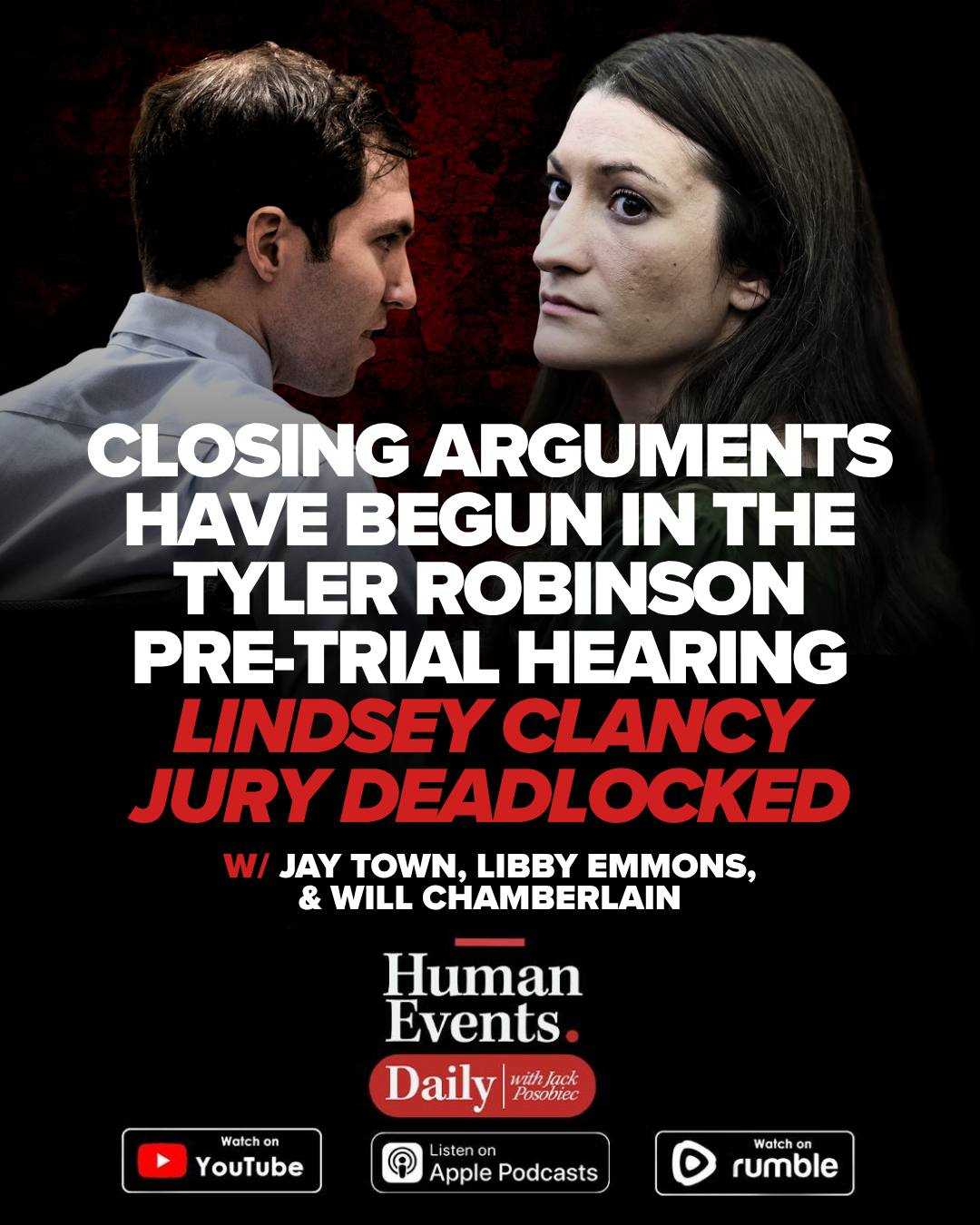
On today's episode of Human Events Daily, closing arguments have begun for the Tyler Robinson case while the jury for the Lindsay Clancy case remains in a deadlock.